
Frontier Quality at a Fraction of the Cost: What We Found Testing GLM-5.3

Open-weight models have improved dramatically. For certain tasks, they’re now performing at a level comparable to frontier models, at significantly lower cost.
At FurtherAI, we evaluated GLM-5.3 on real-world insurance workflows, focusing on two questions:
- Quality: How does GLM-5.3 perform compared to frontier models?
- Cost: How much can we reduce model costs without significantly compromising quality?
The results show why open-weight models are becoming an important part of enterprise AI systems
What we found
We evaluated GLM-5.3 on two production insurance use cases.
1. Submission intake
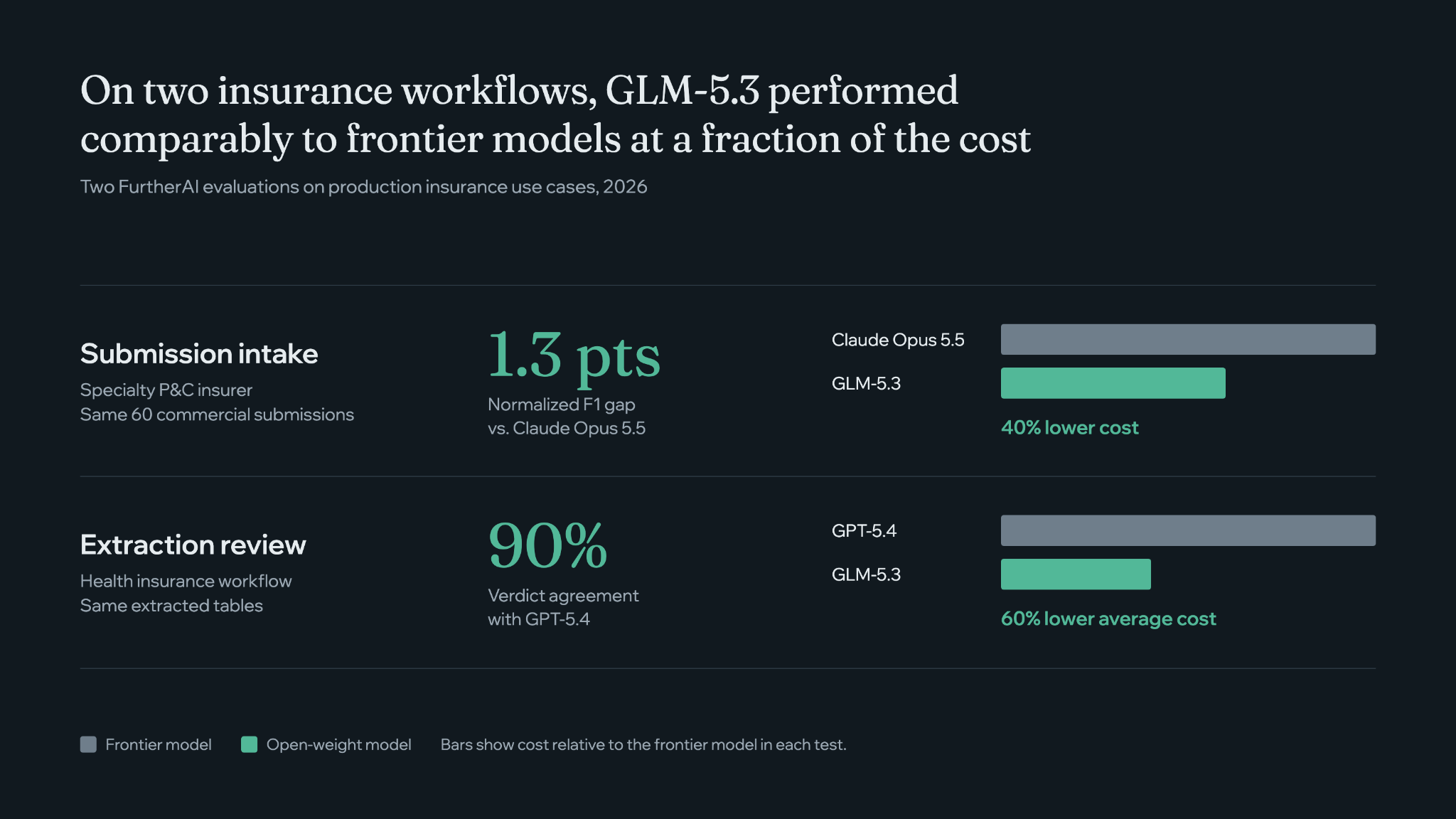
For commercial submissions in a specialty P&C line of business, we tested GLM-5.3 against Claude Opus 5.5.
- Accuracy: GLM-5.3 scored just 1.3 percentage points below Opus 5.5 on normalized F1.
- Cost: GLM-5.3 was 40% cheaper
For a task involving extracting structured information from complex insurance documents, that's a relatively small accuracy gap for a substantial reduction in cost.
2. Extraction review
In a separate health insurance workflow, we evaluated GLM-5.3 against GPT-5.4 for reviewing extracted tables.
- Agreement: Both models reached the same verdict on 90% of decisions.
- Cost: GLM-5.3 reduced average cost by 60%.
Agreement doesn’t necessarily mean equivalent accuracy, but the results suggest that open-weight models are promising candidates for validating extracted information without requiring another expensive frontier-model call.
Why this matters for enterprise AI
Two things make these results particularly interesting.
1. Better economics
Insurance workflows process large volumes of documents: submissions, loss runs, claims, policy documents, and more.
At scale, model cost becomes an important factor in determining which workflows are economical to automate.
Not every task requires frontier-level reasoning. For extraction, classification, and validation tasks with well-defined outputs, open-weight models can often deliver comparable performance at significantly lower cost.
2. More deployment control
Unlike closed-weight models, open-weight models can be deployed within an enterprise’s own infrastructure.
This gives organizations more control over:
- Data: Where sensitive information is processed and stored.
- Model versions: When models are updated and how changes are evaluated.
- Deployment: How models integrate with existing infrastructure and security requirements.
This is particularly relevant for insurance companies handling sensitive customer and claims information.
Combining frontier and open-weight models
The interesting engineering problem isn’t necessarily replacing frontier models with open-weight models. It’s figuring out where each performs best.
We’re already applying this approach in insurance workflows at FurtherAI.
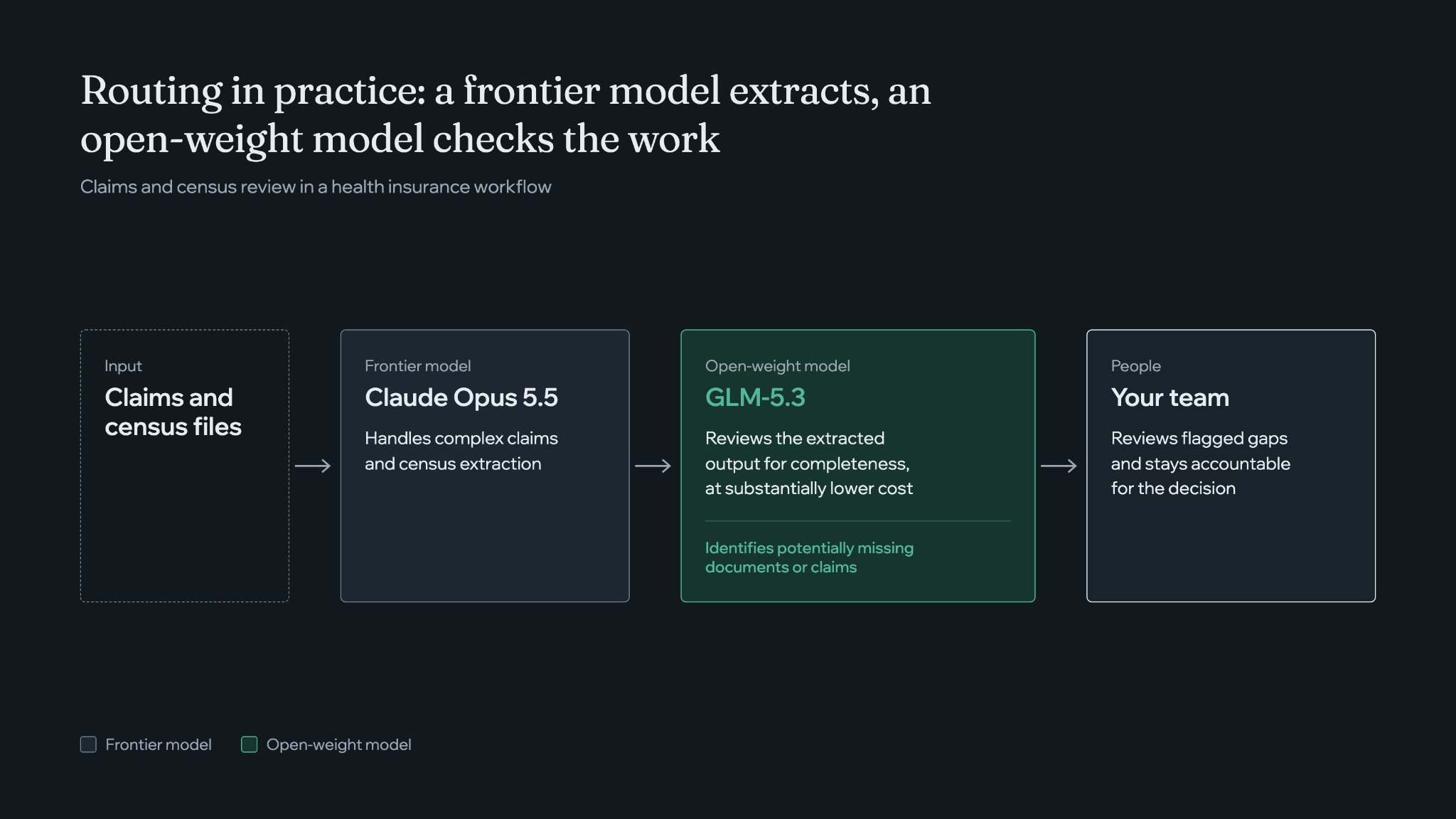
For example, in one health insurance workflow:
- Claude Opus 5.5 handles complex claims and census extraction.
- GLM-5.3 reviews the extracted output for completeness, identifying potentially missing documents or claims.
This lets us use frontier reasoning where it’s needed while keeping the validation pass substantially cheaper.
The same principle can apply across other insurance workflows. Different steps have different requirements for reasoning, accuracy, latency, and cost.
Instead of choosing one model for an entire workflow, we can choose the right model for each task.
That flexibility can meaningfully improve the economics of enterprise AI without compromising the quality requirements of each step
Where domain specialization matters
Choosing between frontier and open-weight models isn’t as simple as comparing generic benchmark scores.
A model that performs well on document classification may struggle with complex claims reasoning. Even within extraction, performance varies with document structure, field ambiguity, and information spread across multiple files.
Making good model-selection decisions requires understanding:
- The type and complexity of the insurance task.
- The documents and information being processed.
- The accuracy requirements and consequences of errors.
- The failure modes of different models.
This is where specialization in insurance becomes particularly valuable.
At FurtherAI, we’re building on our experience across insurance workflows to route tasks to appropriate models, optimizing for accuracy, reliability, and cost.
What’s next
Frontier models will continue improving, and they’ll remain important for tasks requiring complex reasoning.
But open-weight models are improving quickly too. For the right tasks, they’re already competitive at a fraction of the cost.
The opportunity is to combine these capabilities intelligently: use frontier models where their reasoning makes a difference, and lower-cost models where they can achieve the required quality.
The result is enterprise AI that can maintain high accuracy without paying frontier-model prices for every task.
At FurtherAI, we're already putting this into practice. Our insurance workflows combine frontier and open-weight models to optimize for quality and cost, and GLM-5.3 is now available in the FurtherAI Assistant.
DISCLAIMER
This article is for general informational purposes only and does not constitute legal, regulatory, compliance, underwriting, or other professional advice. The content reflects information available as of the date of publication, and FurtherAI undertakes no obligation to update it as laws, regulations, or AI technologies evolve.