FurtherAI Available in Microsoft Marketplace
Introducing Connectors



The Context Gap in Core Systems

The Context Gap in Core Systems
Every insurance system tells you what happened. The policy got bound, the claim got paid, the submission got declined. That's what lives in your records, the final answer, cleanly logged, easy to pull a report on.
What those systems don't capture is everything that led there.
The underwriter who recognized a risk because they'd seen something similar three years ago. The back-and-forth with the broker about appetite that shaped the final terms. The exception that got approved because someone senior said, "this one's okay, but don't make it a habit." None of that makes it into a system. It lives in email threads, in spreadsheets, in the heads of the people who were in the room. When those people leave, it goes with them.
Systems were built to store answers, not capture reasoning
The insurance industry has spent decades building systems of record — faster platforms, cleaner pipelines, better infrastructure. Those investments built the foundation that modern insurance operations run on.
But they were designed to answer one question: what happened? Why it happened, what the reasoning was behind it, was never something technology could reliably capture. When you only have the final state of a decision, you lose everything that shaped it. The context, the judgment, the institutional memory that only comes from doing this work for years across thousands of risks.
The tools that existed were good at storing answers.
They were never built to capture the thinking behind them.
Human expertise filled the gap technology couldn't
Everyone says insurance is a data business. And it is, but look at what actually gets captured.
Policies, submissions, loss runs, endorsements, correspondence. The information that drives decisions exists almost entirely in unstructured form. For most of the industry's history, making sense of that information required human expertise, because there was no technology that could reliably process it at scale.
So organizations built around people. Expertise was hired, developed, and retained. Workflows were designed for human judgment because human judgment was the only thing that worked. That made sense given what was available. General-purpose software was built to store final decisions, not reason over the complexity that produced them.
The result, over time, was an industry where the most valuable asset was also the most fragile, because it only existed inside the people who built it.
LLMs changed what's capturable
Large language models can now process unstructured data, the documents, the correspondence, the forms, with a level of accuracy that makes them viable in production environments where accuracy isn't optional. That's a meaningful shift on its own.
But the bigger change is what becomes possible when AI doesn't just read a document but tracks an entire workflow. The inputs, the decisions, the exceptions, the context, all of it captured in a way that persists and builds. For the first time, the reasoning behind a decision can live somewhere other than inside a person's head.
That's a meaningfully different capability from anything the industry has had before. AI that doesn't just speed up a task but builds an institutional record of how your best people think, one decision at a time.
Every decision leaves a trail
When a submission comes in, extracting the key fields is only part of the job. The AI also pulls context from past decisions, how similar risks were treated, what exceptions were made, what the appetite looks like for this class of business. It knows when to keep moving and when to pause for human input. And it logs what happened at every step, not just the final answer.
That's what a decision trail is. A full account of how the decision was made, not just the outcome it produced.
Over time, those trails become more valuable than any individual workflow. Exceptions stop being one-off conversations and become precedent. The judgment calls that used to leave when someone did now stay inside the organization and build on each other. The account manager who joins next year has access to the reasoning of every experienced colleague who came before them. The underwriter working a complex risk can see how similar situations were actually handled, not just what the policy says. The organization gets smarter as it grows, rather than starting over every time it turns over.
The organizations capturing this now are building an advantage that can't be rushed
The organizations capturing decision intelligence now are building something that takes years to accumulate. Data and systems can be rebuilt. Infrastructure can be modernized. Institutional knowledge that's been captured, structured, and made available across an organization cannot be rushed. The head start is real.
The best people in insurance have always been differentiated by their judgment. FurtherAI was built around the idea that judgment shouldn't have to walk out the door when people do, and that the organizations who figure out how to keep it will operate differently from the ones that don't.
The question isn't whether AI will reshape insurance operations. It's whether your organization will be building institutional intelligence in the meantime.
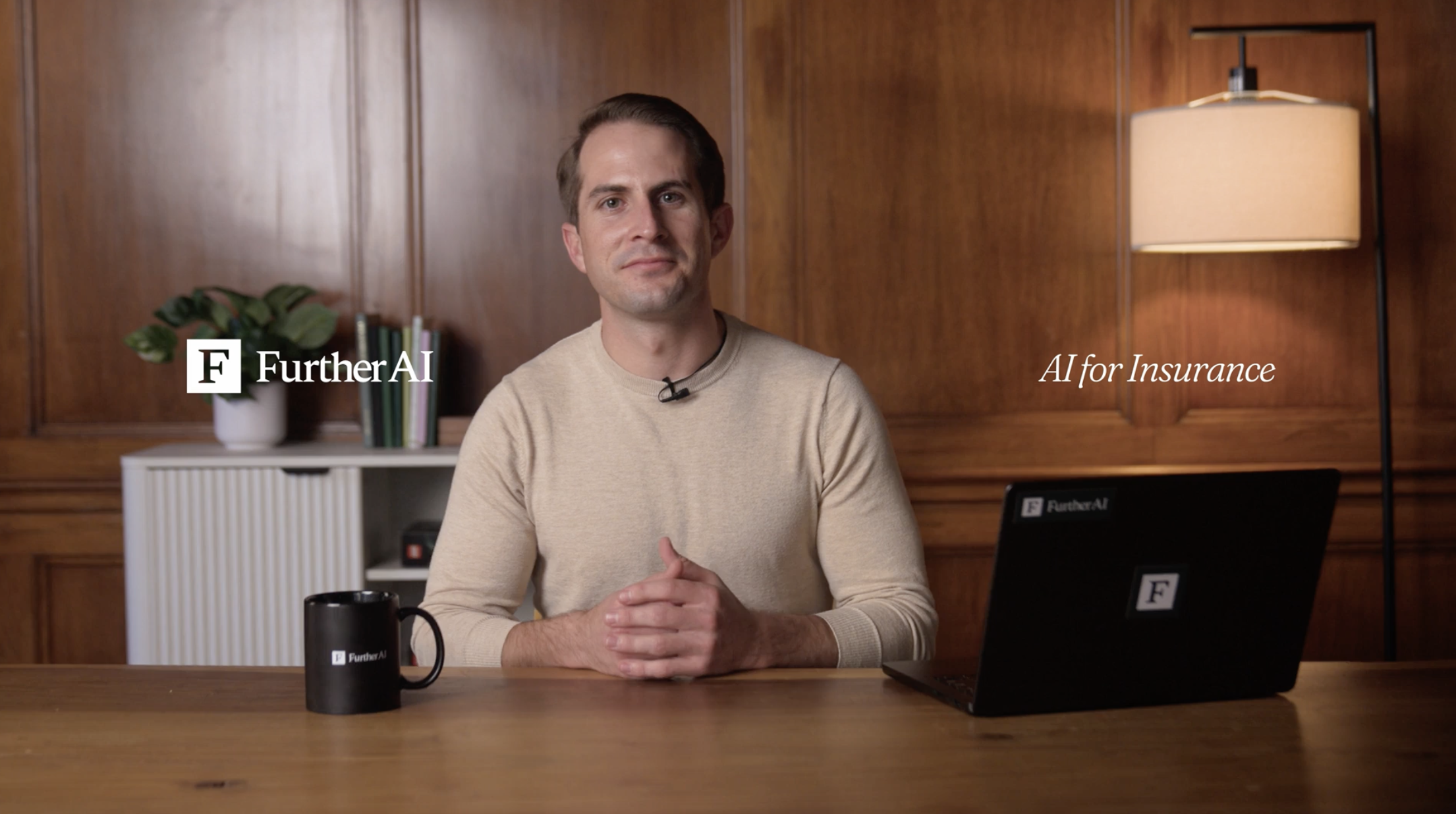
Watch our product lead Danny Olenic break down what this looks like in practice.
Recent posts
Ready to go further and
transform your insurance ops?
Reclaim your time for strategic work and let our AI Assistant handle the busywork. Schedule a demo to see how you can achieve more, faster.




.svg)